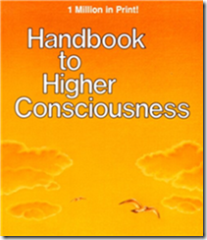
 Looking for a good book on developing coping skills, removing anger, increasing happiness and gaining a sense of peace? There is probably no better book than The Handbook To Higher Consciousness
Amid all the technical chaos that was occurring around us last week, Vince turned to me and asked how I remain so calm while everyone else panics. I didn’t have an answer for him, but I thought back and remembered of some of the deep wisdom contained in Ken Keyes work The Handbook To Higher Consciousness.
The Handbook To Higher Consciousness is a simple book, but it is not easy to master. There are 12 principles one must memorize to get the most from the book.
The main philosophy is that whenever you are feeling angry, depressed, sad or other negative emotion it is because of a conscious “addiction” of some sort. The way it works is whenever you are upset in any way, you put your emotion up against one of the 12 principles.
I read it in my twenties while I was still loading trucks for a living. Anyone who’s worked a loading dock knows everyone is mad all the time. It’s hot, boxes are heavy, bosses are like drill sergeants so it doesn’t make for a great attitude. Keyes would call the perfect atmosphere to apply his consciousness methods. So that’s what I did.
I remember back then it seemed everyone was divorced, going through a divorce or had a troubled marriage. Something about getting up at 2a.m. to go to work interferes with a relationship.
I wasn’t married, but like the other guys I was going through a difficult breakup with a woman I dated for about a year. This further inflamed my work. I was hurt and angry by my perceived mistreatment by the world. Life just wasn’t fair. 
One benefit of loading trucks is you can do other mental tasks at the same time. In fact, a couple of us who were in school were able to do deep study of our topics because we’d do anything to take our minds off the heavy lifting. Memorizing the chemical elements and other boring topics were virtual oasis away from big brown boxes, pipes and engine parts.
Like I said, this was the perfect atmosphere to apply the Handbook to Higher Consciousness. The book is a guide to expelling negativity and leading a life of happiness. If I could do it there, then it worked.
My first step was to memorize the 12 principles. I’d pick up a crate, repeat a sentence as I loaded it on the truck. Grab another box, and repeat the second, and so on. It wasn’t efficient, but neither was hand loading trucks. I seemingly had all the time in the world so it was relaxing to repeat these messages over and over in my mind.
I mentioned before the point of the book is to expel conscious “addictions” from your mind. I don’t believe “addiction” is an accurate word, but it is the closest word to describe Keyes vision of what happens mentally when you get angry, sad or upset.
Keyes points out that when we get angry because someone cuts you off in traffic, it is because you are “addicted” to having a smooth and unfettered trip to work. Let’s think about that for a second. What could be more ridiculous than expecting that every single day you’ll drive to work, no delays, no stoplights, no bad or incosiderate drivers? Yet, so many of us raise our blood pressure and anger level when someone else deviates from the norm. We honk our horns, throw up our hands, give the one finger salute and others actually get out of their cars and come to blows.
But why?
We already know that to expect a perfect drive to and from work every day for our entire lives is a ridiculous notion. So why would you get upset by an incident when it happens? Ahh… That is Keyes philosophy in a nutshell. It is our mental addiction to complete order on our trip and the removal of what we are addicted to that leads to becoming upset.
Keyes would insist the second you feel the adrenaline kick in and you start to feel defensive that you instead repeat philosophy #3 “I welcome the opportunity (even if painful) that my minute-to-minute experience offers me to become aware of the addictions I must reprogram to be liberated from my robot-like emotional patterns..”
You may not like to think of waving your fist in the air and screaming a side effect of addiction. However, if you think of the actions taken by people who are addicted to drugs or alcohol, they react much in the same way when their drug is scarce.
Life Without Emotional Addiction
I’d probably call a life free of this type of addiction impossible or nearly impossible. Maybe some Monks reach this level of consciousness, but their lives are less burdened by societal pressures, crime and just the day-to-day unpredictability of modern day life.
With that said, there is a much happier existence to be had when you begin to let go of negative emotions. A traffic jam that once made your head steam now is a slow moving parade of different sights, sounds and personalities. Personally, I can sit in a traffic jam and feel a sense of relaxation other people don’t achieve while sleeping.
You might ask how I can stay calm and even enjoy a traffic jam. The reason is it gives me an opportunity to watch. I can choose to people watch because people make some interesting expressions during a traffic jam. Or I can relax and listen to one of the many self-development courses in my car. Or I can simply sit back and listen to music. Or turn it off and think.
Reacting emotionally to all in life is the low consciousness effort. While reacting thoughtfully is a higher consciousness effort. It’s not always easy, but it does get easier as you practice.
And to those of you who might be wonder if this turns you into an unemotional robot, nothing could be further from the truth. Life simply throws too many varying situations at us to live without emotion. Keyes doesn’t promote for an emotionless life anyway. He says we need to form an awareness of not only our emotions, but those of others as well.
By becoming aware of how your actions might upset another person, his teachings lean toward not doing that. Put another way, part of the responsibility of having a higher consciousness, means not picking on others or antagonizing their addictions.
Keyes philosophy about arguments is that one should express “preferences” instead of making demands based on addiction. An example would be if your spouse leaves the cap off the toothpaste you wouldn’t get upset about it. You?d simply say “I’d prefer it if you put the cap back on the toothpaste.” If your spouse doesn’t comply, repeat the preference calmly, without accusing anyone.
This interaction means you take responsibility for your own preferences without beating someone over the head with it. .
I am thinking I will follow up this post with a discussion of some of the other addictions, so subscribe to my RSS feed and you will not miss any future installments.
– Brad Isaac
More Info: The Handbook To Higher Consciousness




{ 2 trackbacks }